


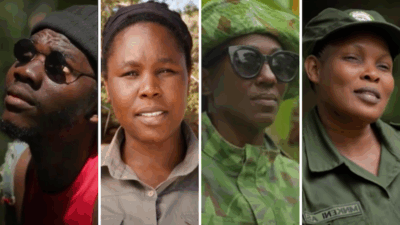
Across Africa, there are men and women defending nature — protecting vulnerable wildlife and habitats and creating a more sustainable future for their communities. We are celebrating their impact in a series called “Nature’s Champions.”
WildAid believes in collaborating with, empowering, and amplifying the voices of impactful and inspiring conservationists around the world. This reflects our core belief that that conservation is a team sport, and that it must include local people to be successful and sustainable.
We’ll release one new “Nature’s Champions” film every two weeks throughout 2026, spotlighting extraordinary individuals from Cameroon, Gabon, Nigeria, Tanzania, and Zimbabwe. Check this page to see the new stories as they’re posted!
Cédric Batoto Axel – Gabon
Cédric Batoto Axel has worked as an industrial fishing observer in Gabon for more than a decade. His role involves not only collecting data on fishing vessels operating in Gabon’s waters, but also educating and encouraging ship’s captains to fish responsibly.
His role sometimes brings him into conflict with those captains, when he sees boats breaking the law by fishing in protected areas, fishing without permits or catching protected species. But he believes passionately that fishing has to be sustainable, to protect nature and conserve resources for future generations.
“The work of an observer is not an easy job,” he says, “but I would say it is one of the most beautiful professions. The motivation mainly comes from knowing we are doing something good.”
Cédric says he has felt a deep innate connection with the sea ever since he was a child and he is passionate about protecting the oceans.
“The oceans are our future, but at the same time they are also becoming the past, because what happens at sea is far from sight,” he says. “The oceans are emptying in indifference and in silence, which is precisely why we need observer programs.”
Appolinaire Ndohoudou – Cameroon
Meet Appolinaire Ndohoudou, a site manager at Ape Action Africa in Cameroon’s Mefou Park — and a dedicated champion for chimpanzees and gorillas.
Ndohoudou began his journey in 2002 as a night watchman. Soon after, he joined the team at Mefou Park, home to the Ape Action Africa Primate Sanctuary, where he was trained to care for rescued chimpanzees and gorillas. Over the years, his role has grown — but his commitment has remained the same.
Today, he helps protect apes threatened by poaching and the bushmeat trade. In Cameroon’s eastern forests, where poachers are active, chimpanzee and gorilla populations have declined dramatically.
That’s why the work of sanctuaries and eco-guards is so important — offering protection, care, and a second chance for animals that have survived these threats.
Where Cameroon’s forests were once full of chimpanzees and gorillas, far fewer remain. Protecting them has never been more urgent.
Rachel Ashegbofe Ikemeh – Nigeria
Meet Rachel Ashegbofe Ikemeh, founder of the South-West Niger Delta Forest Project in Nigeria, and a champion for some of the country’s most endangered wildlife.
Rachel focuses her research on the Niger Delta Red Colobus Monkey and the Nigeria-Cameroon Chimpanzee. These two species became flagships for her work, helping drive the protection of entire forest ecosystems and the many other endangered species that depend on them.
In 2020, the Ekiti State Government approved the creation of a 3,330-hectare conservation area in Ise Forest. At the heart of this protection are the rangers — or as Rachel says the “frontline conservationists” — who gather vital wildlife data, uphold the law, and defend the forest.
At least nine endangered species are safeguarded within this landscape. Protecting chimpanzees means protecting their home, and everything within it.
Despite pressure from illegal logging and bushmeat demand, Rachel and her team work with communities to build awareness and protect the forest. Because, as she says, extinction is a real threat and protecting Nigeria’s forests is a shared responsibility.
Supuk Olekao – Tanzania
Across Tanzania, communities living alongside wildlife have been empowered to manage their lands and generate income from nature.
These lands are called wildlife management areas, or WMAs.
The people who work there are dedicated to improving lives within their communities – and protecting nature. We call them Nature’s Champions.
This is the story of Supuk Olekao, who works as the manager of Makame Wildlife Management Area in northern Tanzania.
Danièle Tjomb – Cameroon
When the forest began to fall silent, Danièle Tjomb knew something vital was being lost.
Danièle is a water, forest, and hunting engineer at Cameroon’s National School of Water and Forestry, and a champion for the forests that shape her country’s culture, identity, and future.
She has always felt a deep connection to and responsibility for the forest and its animals. However, returning to her hometown to visit, she noticed something troubling. The forests that were once alive with the calls of monkeys and other animals had fallen silent. That silence tells a story of deforestation and loss.
For Danièle, protecting forests is about more than biodiversity — it’s about preserving who Cameroonians are.
“To me, there is a connection between nature, animals, and traditions, so we can’t dissociate nature, animals, and Cameroonian culture,” she says. “If it happens that our forests disappear, we are going to lose our cultural identity.”
In her role at the National School of Water and Forestry, Danièle is both a teacher and a leader. She oversees eco-guards and leads the operational unit for capacity building in forest management, helping strengthen the skills needed to protect Cameroon’s forests and wildlife. She finds purpose in this work because safeguarding the forest means thinking beyond today and toward future generations, including her own children.
Cyrille Mvele – Gabon
Cyrille Mvele’s work is an example of how conservation efforts succeed when people and nature thrive together.
Co-founder of OELO, an organization created in 2010 to protect Gabon’s Lake Oguemoué (part of the Bas Ogooué wetland) and its biodiversity, Cyrille has built a model of community-led conservation rooted in dialogue, shared responsibility, and local pride. By working hand in hand with surrounding villages, he helps communities understand the environmental challenges they face, identify their causes, and co-create practical solutions that protect ecosystems and aquatic resources while generating sustainable income.
Under his leadership, OELO has reached thousands of students in 31 schools through environmental education programs, reduced poaching and trade of protected species, and supported the creation of multiple fishing cooperatives and no-take zones that safeguard the lake while securing livelihoods. Together with his wife, Cyrille also founded a community-run eco-lodge on his ancestral land, transforming sustainable tourism into a tool for conservation, cultural transmission, and economic resilience.
Cyrille’s work shows that when communities are empowered to protect the places that shaped them, conservation becomes a source of pride, opportunity, and hope. His model is already inspiring the next generation and will continue to benefit both people and nature for decades to come.
Eric Kaba Tah – Cameroon
Meet Eric Kaba Tah, Deputy Director of LAGA Wildlife Law Enforcement in Cameroon — and one of the country’s most determined champions for wildlife.
Eric draws his inspiration from the forests, its sounds, its beauty, its diversity, But early in his conservation career, Eric noticed a problem: wildlife crimes were being committed, but rarely prosecuted. The deterrent factor was the “missing ingredient” in conservation in Africa, he says.
Instead of accepting the status quo, Eric and his team worked with the government to build a model that ensures wildlife laws are enforced and offenders are held accountable.
“The message I want to give to traffickers is that: ‘Look, there is a law that protect these animals, and anybody who goes against the law will be arrested. If you get arrested, you will not be able to bribe your way out of it. You are going to jail.’”
But law enforcement is only part of the solution. Recognizing that bushmeat consumption is one of the leading drivers of wildlife decline in Cameroon, Eric is also focused on shifting public attitudes — encouraging Cameroonians to reconnect with long-standing values of wildlife stewardship and coexistence with nature.
Stay in touch and get the latest WildAid updates.
SIGN UP