


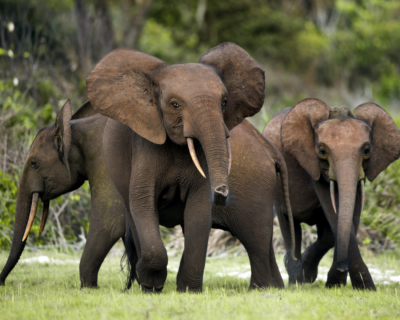
Forest elephants spend their days munching on fruit and leaving a little bit of gardening behind wherever they go. As these gentle giants forage over long distances, they trample and clear away dense vegetation, creating pathways through the forest. Along the way, they spread seeds in their nutrient-rich dung, giving new trees the chance to grow. It’s no wonder forest elephants are known as “mega-gardeners.”
Their gardening services have a climate benefit, too. While thinning out the forest floor, elephants give the seeds they disperse more access to sunlight and water. Over time, the trees that take root have the space to grow larger and taller — and the mightier these trees become, the more carbon they can store. By helping the rainforest grow and maintain these carbon-rich trees, forest elephants act as powerful allies in the fight against climate change.
In fact, each forest elephant can stimulate a net increase in carbon capture of 9,500 metric tonnes of CO2 per sq km of rainforest. That’s equivalent to emissions from driving 2,047 petrol cars for one year!
Where the forest elephants call home
Located along the Atlantic coast of Central Africa, Gabon is home to roughly two-thirds of the world’s remaining forest elephants and sits within the vast Congo Basin — the second-largest rainforest on Earth and one of the planet’s most important carbon-storing ecosystems.
Nearly 90% of Gabon is covered in forest, earning it the nickname “Earth’s Last Eden.” The country has long been a leader in conservation, with protections in place for 21% of its land and nearly 30% of its waters. But even in this conservation powerhouse, forest elephants face an uncertain future.
Since 1980, forest elephants have lost more than 86% of their population. Just 100,000 remain today — equivalent to 10% of their potential population size. Their slow reproduction, combined with human pressures from illegal logging, mining, and poaching, has put their survival at stake.
“Forest elephants shape the entire ecosystem,” said Simon Denyer, Africa Program Manager at WildAid. “If we lose them, Gabon’s forests will change, and the entire structure of the Congo Basin will change, too. Gabon is truly their last stronghold and a testing ground for their survival.”
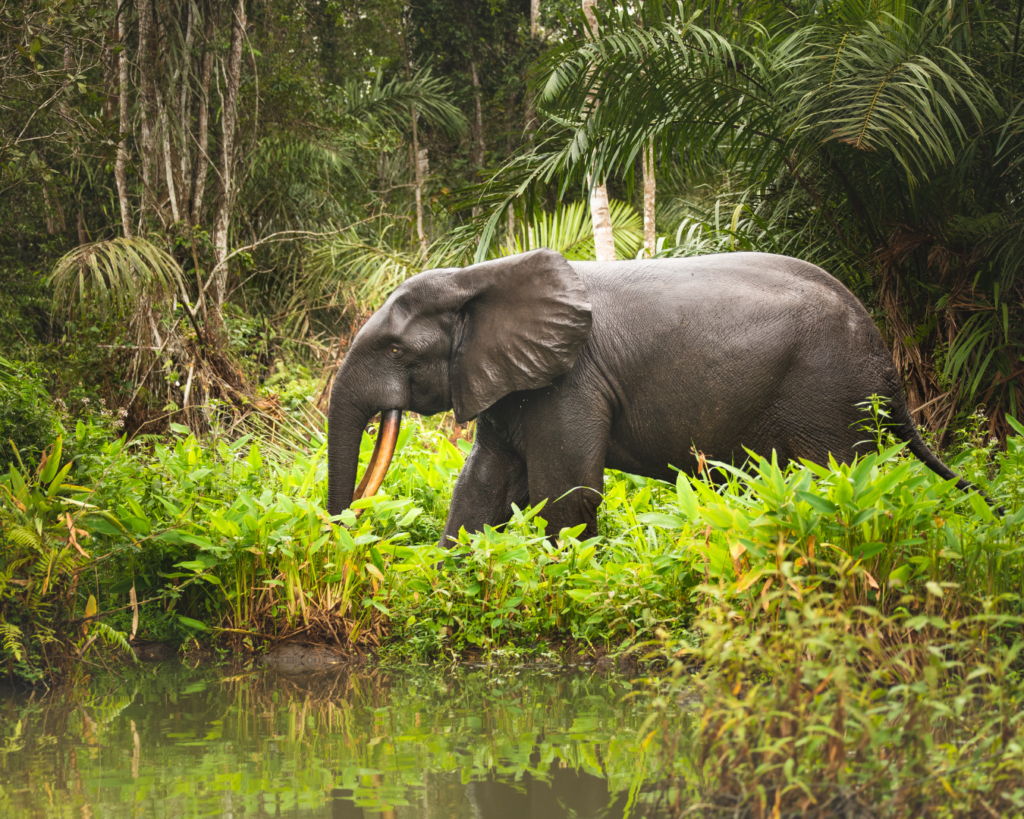
Protecting Gabon’s mega-gardeners
In Gabon, WildAid is working to raise awareness of the consequences of environmental crimes, build public support for conservation, and help shift national behavior.
With the support of the U.S. Embassy in Libreville, WildAid launched a campaign to promote forest conservation and underline the economic, environmental, and social costs of illegal logging. Working with Gabonese influencers, and celebrating Gabonese conservationists, the campaign aims to reinforce national pride in and appreciation of the country’s magnificent natural wealth.
WildAid is also working with communities living alongside Gabon’s forests to encourage local action and pride in protecting natural resources. By helping communities recognize and report environmental crimes, the program aims to make illegal activities like poaching and illegal logging increasingly unacceptable and turn public concern into action.
But reporting crimes is only half of the equation. Strengthening enforcement when environmental crimes occur is critical to creating meaningful change. WildAid is providing technical assistance, assessments, training and guidance to Gabonese agencies to improve monitoring, control, and surveillance of these crimes. We’re also working with the government to establish a national, anonymous environmental crime reporting hotline that will further empower citizens to report illegal activity safely.
Together, these efforts help create the conditions forest elephants need to survive: healthy, protected forests and communities empowered to defend them.
Protecting forest elephants means protecting far more than a single species. These gentle giants help shape the forests that sustain a multitude of vulnerable species including gorillas, hippos, chimpanzees, and pangolins. And by supporting one of the planet’s most important natural defenses against climate change, these forests also help safeguard the people and communities that depend on them.
Protecting forest elephants requires both local stewardship and putting tools and systems in place for effective enforcement. By collaborating locally to build public support, strengthen conservation systems, and empower communities to report environmental crimes, WildAid is helping make that protection possible.
When forest elephants thrive, forests thrive with them. And when those forests remain standing, they continue to shelter vulnerable wildlife, support communities, and store carbon for generations to come.
Stay in touch and get the latest WildAid updates.
SIGN UP