


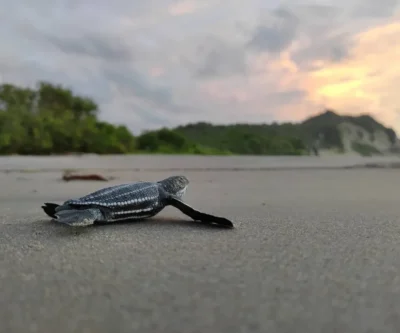
Something very exciting happened on the night of January 9, 2026 in Crucita, Ecuador — a leatherback sea turtle returned to the beach where she was born to lay her eggs, a process called natal homing. WildAid’s conservation partners at Fundación Contamos Contigo were conducting coastal patrols when an alert came through their community monitoring network that a turtle was spotted coming ashore. Within minutes, the team was on site with the support of local authorities.
Roddy Macias, WildAid’s Coastal Ecuador Project Manager, was at his house nearby when he got the news and hurried to the beach. It was the first time he’d seen a leatherback turtle up close. Her dark shell, patterned with pale spots and the seven ridges that distinguish leatherbacks from other species, moved slowly across the sand. “It was a very special moment,” he says.
The nesting process lasted approximately three hours, during which a physical examination of the turtle was conducted, biometric data was collected, the turtle was tagged for tracking, and it was verified that the female showed no injuries or abnormalities associated with the process of coming ashore, laying eggs, and nesting. The monitoring ensured that the turtle was able to deposit her eggs and build the nest safely, without interference, before successfully returning to the ocean. Only then did the team assess the risks around the nest and carefully relocate it to a safer site where it could be protected.
This incredible event comes just five years after a major conservation milestone, when 69 leatherback sea turtle hatchlings were born and safely released to the sea in January 2021 — the first leatherback hatching event in Ecuador in nearly 40 years.
Moments like these don’t happen by chance. They are the result of years of trust and collaboration — proof that when local communities are empowered with resources and long-term support, sea turtle conservation thrives.
“Many community members have become true experts in marine protection, and they have a huge multiplier effect on societal awareness,” says Macias. “WildAid has accompanied this process by providing materials, equipment, and training over the years.”
View this post on Instagram
For more than a decade, WildAid has equipped and empowered park rangers, nonprofits, and community volunteers across the coast of Ecuador to support crucial sea turtle conservation projects. These initiatives include tagging, nest protection, releasing hundreds of thousands of baby turtles into the sea, rescuing and treating turtles injured by fishing gear or marine plastics, and educating the local community about the importance of sea turtles.
Ecuador’s coastline stretches 1,400 miles from Colombia to Peru, encompassing estuaries, mangroves, mountains, beaches, bluffs, islands, shallow waters, and rocky and sandy sea beds. The convergence of ocean currents in this region creates ideal habitats for five threatened or endangered sea turtle species — green, leatherback, loggerhead, olive ridley, and hawksbill — making it one of the most biodiverse coastal areas in the world. Marine conservation is a top priority here, reflected in the country’s network of 20 protected coastal and marine areas.
Unfortunately, threats to these graceful swimmers are plentiful. Sea turtles can get trapped in fishing nets, unable to reach the surface to breathe, or get hooked or entangled in longlines — fishing lines that can stretch over a mile and carry hundreds or even thousands of hooks. They can accidentally consume floating plastic that coats their gut and leads to starvation.
On land, artificial lighting along beaches can deter females from coming ashore and disorient hatchlings trying to find the sea. Shoreline armoring (e.g., sea walls) can result in the complete loss of dry sand suitable for successful nesting, while beach driving can destroy nests. Sea turtles are also killed for their eggs, meat, skin, and shells.
Faced with these growing pressures, the role of local communities is critical to sea turtle survival. During Ecuador’s 2024-2025 nesting season, a total of 1,730 turtle nests were protected and more than 103,500 hatchlings reached the sea. Behind these numbers are the efforts of hundreds of volunteers, partners, and community members serving as “Tortugueros” (turtle protectors).
Since WildAid started supporting sea turtle conservation efforts in Ecuador in 2015:
- 17,000 coastal patrols conducted by park rangers and volunteers, covering 53 beaches
- More than 350,000 sea turtle hatchlings have safely reached the ocean
- 500 sea turtles have been rescued and provided with medical care
Back in Crucita, the leatherback nest sits quietly under protection, marked and monitored by the same community members who responded that first night. If all goes well, tiny hatchlings will emerge in March and begin a journey to the open ocean. After 10-15 years, they’ll migrate back to this very beach to nest and lay their own eggs — beginning another generation of leatherbacks.
Stay in touch and get the latest WildAid updates.
SIGN UP