


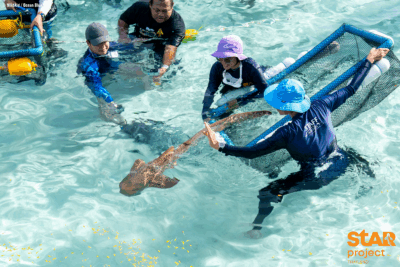
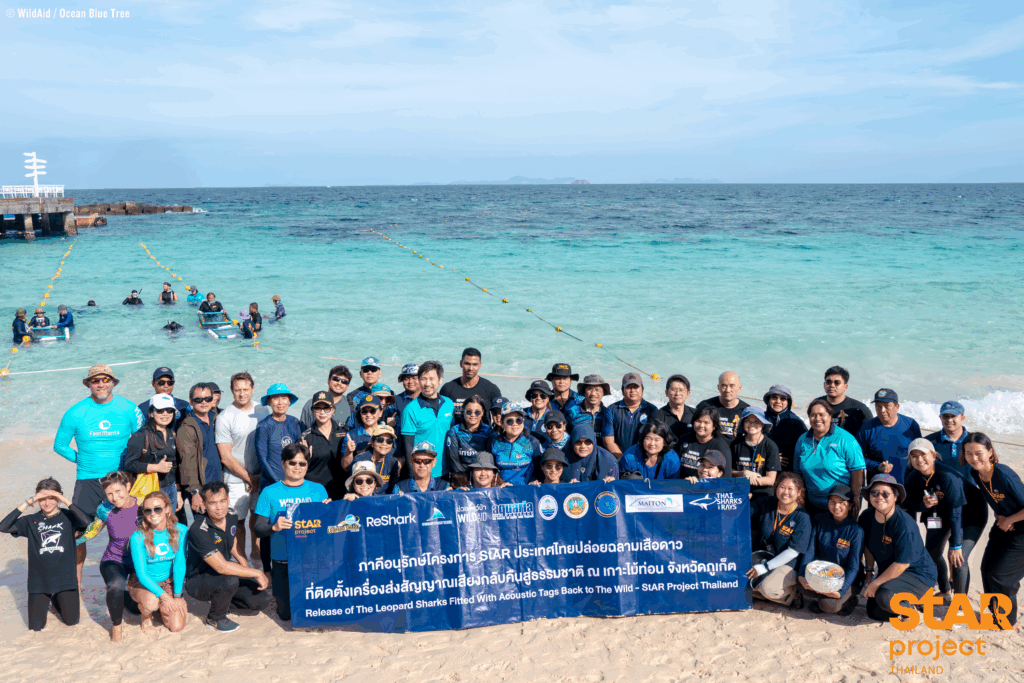
Four Indo-Pacific leopard sharks have been released off the coast of Thailand, an exciting step forward for the recovery of this endangered species! Following the successful release of three leopard sharks in September, this event marks another major milestone for the country’s first-ever leopard shark rewilding program, the “StAR (Stegostoma tigrinum Augmentation and Recovery) Project Thailand.” This brings the total number of sharks released by the project in 2025 to seven.
On December 8th, the four young sharks — Maiton, Hope, Spot, and Toty — were released from Maiton Resort, located just off the southeast coast of Phuket Province. Before the sharks entered the open ocean, StAR Project Thailand partners performed a blessing ceremony, pouring seawater adorned with flowers into the sea as a symbolic gesture wishing the sharks a safe and successful return to their natural habitat.
Indo-Pacific leopard sharks are easily recognized by their distinctive spotted pattern and long, graceful tails. They help regulate populations of invertebrates and small fish, maintaining the ecological balance that supports reef health and biodiversity. Yet habitat degradation, overfishing, and accidental capture in fishing gear have caused steep population declines in Thailand’s waters in recent decades.
According to the latest Population Viability Analysis (PVA), prepared by Dr. Philip S. Miller, Director of Science and Data at the IUCN SSC Conservation Planning Specialist Group, the current wild population of leopard sharks in the Andaman Sea, the stretch of ocean along Thailand’s west coast, is estimated to be between 57 and 172 individuals. This is a fraction of the region’s estimated carrying capacity of roughly 1,000 sharks. This rewilding effort is urgently needed to boost population growth, safeguard genetic diversity, and reduce extinction risk.
As Thailand’s lead agency responsible for marine research and conservation, the Department of Marine and Coastal Resources (DMCR) has been working hand-in-hand with partners from the StAR Project Thailand from the very beginning. Together, the team received juvenile leopard sharks from Aquaria Phuket, reared them, and trained them to hunt natural prey within an enclosed sea pen at Maiton Resort. Prior to release, the team also carried out health assessments and implanted acoustic transmitters in the sharks, in partnership with veterinary teams from Ocean Park Hong Kong.
This collaborative effort extends into the ocean itself. Working alongside the Department of National Parks, Wildlife, and Plant Conservation, the StAR Project Thailand installed a network of 20 underwater acoustic receivers — critical tools that allow experts to monitor the sharks’ movements, behavior, and survival once they return to the wild.

“Today’s release is not only a symbolic milestone, but also a reaffirmation of the strong collective commitment of all sectors: government agencies, private organizations, conservation partners, and the public, including the diving community, to restore Thailand’s marine ecosystems and preserve their balance for future generations,” said Pinsak Suraswadi, Director-General, DMCR.
The acoustic transmitters fitted to the sharks emit a unique frequency that can be detected by the acoustic receivers deployed across Phang Nga Bay, spanning the waters between southern mainland Thailand in Phang Nga, Krabi, and Phuket Island. The Bay was identified through citizen science data as a hotspot for leopard shark sightings and is considered an important habitat for the species. When a tagged shark swims within approximately 500 meters of a receiver, the tag’s ID is automatically recorded in the receiver’s data log along with date and time.
Data retrieved in November confirmed detections of the three previously released sharks — Maya, Similan, and Ginger — within 16 kilometers from the release site, up to 50 days after their release. The sharks were detected around Koh Dok Mai (Phuket Province), Koh Khai Nok (Phang Nga Province), and Hin Musang (Shark Point) near Phi Phi Island. These detections indicate that the sharks are actively exploring a wider area and suggest that these areas provide suitable habitat for juvenile sharks to forage and thrive.
To support ongoing monitoring of the released sharks, the StAR team is conducting outreach with diving operators and boat crews around Phuket, encouraging them to continue promoting the submission of leopard shark photos and videos taken in Thai waters through the “Spot the Leopard Shark – Thailand” platform. These community contributions help scientists track individual sharks, particularly those released through the project, and monitor population trends over time.
The StAR Project Thailand reminds the diving community to refrain from touching or moving the receiver devices if they come across them at dive sites. These devices are safe, non-hazardous, and essential for marine research. Divers are also encouraged to report any loose or damaged receivers through the project’s platform.
###
For inquiries, please contact:
Natthanan Phariwong, Project Coordinator, StAR Project Thailand, WildAid
Tel: +66953952423 | Email: natthanan@wildaid.org
Metaveee Chuangcharoendee, Project Manager, StAR Project Thailand, WildAid
Tel: +6681 8219612 | Email: metavee@wildaid.org
Patranan Suphangkanan, Senior Program and Communications officer, WildAid
Tel: +6689 520 4555 | Email: patranan@wildaid.org
About StAR Project Thailand
The Stegostoma tigrinum Augmentation and Recovery Project (StAR Project), originally initiated by ReShark, is a global effort to restore populations of the endangered Indo-Pacific leopard shark (Stegostoma tigrinum) in regions where the species has disappeared or dramatically declined due to overfishing and habitat degradation. The StAR Project Thailand was officially launched in Thailand in May 2025 through a multi-sector collaboration involving key Thai government agencies, the private sector, and non-profit organizations. The current project’s partners include the Department of Marine and Coastal Resources (DMCR), Department of National Parks, Wildlife and Plant Conservation (DNP), the Department of Fisheries (DoF), Aquaria Phuket, Maiton Resort, WildAid, Ocean Blue Tree and Thai Sharks and Rays. The project aims to rebuild wild populations of the Indo-Pacific leopard sharks, Thailand’s protected and endangered species, by breeding, raising, and releasing them in their historic range, helping to restore balance to marine ecosystems where these key predators play a vital role.
Stay in touch and get the latest WildAid updates.
SIGN UP