


By Simon Denyer, Africa Program Manager at WildAid
Like many Brits, my lifelong love of nature was inspired by the BBC’s incredible wildlife narrated by David Attenborough, starting with Life on Earth way back in 1979. In three decades of my professional life as a journalist, some of the most enjoyable and inspiring stories I wrote were about nature conservation, and the successful efforts to turn back the tide of environmental destruction. My own stories for the Washington Post about WildAid’s successful behavior change to reduce demand for ivory and shark fin took me on a journey that eventually took me to my current role as Africa Program Manager for this organization.
A belief in the power of the media to inspire us to conserve our planet and the animals and plants we share it with is hard-wired into my being.
In five years at WildAid, I have tried to turn that belief into action, and reinforce WildAid’s existing efforts to harness the media to change social norms about wildlife and the environment, and to change people’s behavior in positive ways.
In Cameroon, we proudly partnered with private TV channel Vision 4 to produce Wild Cameroon, a debate show discussing the country’s spectacular natural heritage and how best to protect it, with some of Cameroon’s leading experts in conservation joined by government officials, private sector representatives and ordinary citizens. In Nigeria, we partnered with Arise TV to produce the award-winning docuseries Go Wild. In Tanzania, we are partnering with the Tanzania Safari Channel to produce a series about community-led conservation, which will be launched in early 2027.
Those collaborations, and others like them, have not only brought conservation stories into people’s living rooms across Africa, they have also built local media capacity to report on conservation. That capacity-building work doesn’t end there, though. Last year in Gabon, we conducted a week-long training course for journalists in environmental investigative journalism, and followed that up with the launch of Gabon’s first-ever awards for environmental journalism.
Those awards followed a template we had pioneered in Uganda, in partnership with the Uganda Wildlife Authority. The fourth edition of the Uganda Conservation Media Awards will be celebrated in Kampala later this month, and have gone from strength-to-strength. Each year, we see better journalism, and better stories, from more locations, with more journalists and more media organizations entering, from all across the country.
The idea is simple: recognize the best work, raise the profile of conservation reporting and build a community of journalists who can explain why conservation matters, through stories that people can understand and connect with.
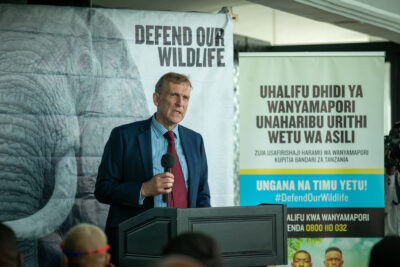
We make our own award-winning documentaries too, from Tanzania: Land of the Lion that explores how communities are coming together to protect Africa’s most iconic animal, to our Nature’s Champions series, five-minute-long films celebrating some of the unsung heroes of African conservation, explaining in their own words what inspires them. And we work directly with the media, whether that’s appearing on radio shows or holding press conferences that get issues online, in print and on television. At the same, we recognise that independent journalism provides
But how does this fit in with our more conventional behavior change work? WildAid has pioneered the use of nationally famous influencers and trusted messengers to directly ask people to take action to save wildlife, to stop buying ivory or eating pangolin meat. That work, disseminated through PSA films, billboards and radio slots, includes a direct call-to-action and has a measurable impact. Has elephant poaching gone down, has ivory trafficking abated and black market ivory prices fallen? (Yes). Has consumption of pangolin meat fallen and has the price of scales been reduced? (Again, yes).
The impact of the media work I have described is perhaps harder to gauge, but it is no less important to our campaigns. Through our media work, we help to make Africans (and Asians) proud of nature, invested in its conservation and have a better understanding of the role they can play in protecting it for future generations.
In Cameroon, for example, our goal is to reduce urban consumption of pangolin meat, but we can’t only do that by telling people what not to do. Our opinion surveys found that Cameroonians were proud of their country’s diverse nature, and concerned about deforestation. But they were still, in unsustainably large numbers, eating pangolin meat.
Our goal is to stimulate a national conversation about conservation, and place pangolins at the centre of that conversation. To encourage people to associate them with forests, with lions and gorillas, things that they are proud of, and not with a tasty dinner option. And we do that through Wild Cameroon, through Nature’s Champions and one day, we hope, by launching environmental media awards in Cameroon.
Our social media strategy also builds on that goal, to inspire pride in nature and encourage practical, everyday action to support conservation.
But when people (and politicians) see our social media posts, we want them to think, “Ah yes, I saw something about pangolins on TV last week. This is worth my attention.” Media coverage can provide essential, independent validation of the messages we are trying to put across. In that way, it can magnify their impact significantly.
A social media post might hit the nail on the head, but our media work softens the wood into which that nail is being hammered.
Stay in touch and get the latest WildAid updates.
SIGN UP