


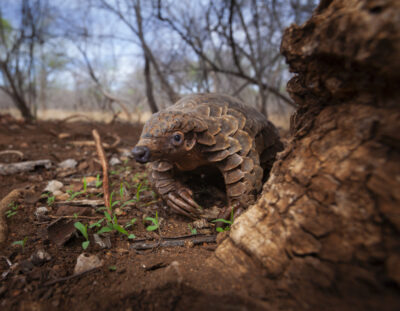
Meet the pangolin: a shy, scale-covered mammal whose name comes from the Malay word pengguling, meaning “roller” or “one who rolls up.” When threatened, that’s exactly what they do: curl into a tight ball of armor, transforming into something that resembles a pine cone.
While this defense mechanism is effective against big cats and other would-be predators, it’s no match for poachers. An estimated 200,000 pangolins are taken from the wild every year to meet the demand for their meat and scales, making them the most trafficked wild mammals on Earth.
Pangolins are quietly disappearing before many people have even heard of them. The more we talk about them, the more awareness we raise, behaviors we help change, and momentum we create for their protection.
Here are six facts about pangolins to get you better acquainted:
1. They’re the only mammal on Earth covered in scales
Intricately overlapping layers of scales coat the entire length of the pangolin’s body, like nature’s own suit of armor. Often mistaken for reptiles, pangolins are actually warm-blooded mammals who nurse their young, just like we do.
At any sign of danger, the pangolin curls into a ball locking its scales into a protective shield. These hard scales protect the pangolin’s soft body from predators like big cats and hyenas, who often give up after struggling to bite through the sharp-edged shield.
2. Baby pangolins are called pangopups
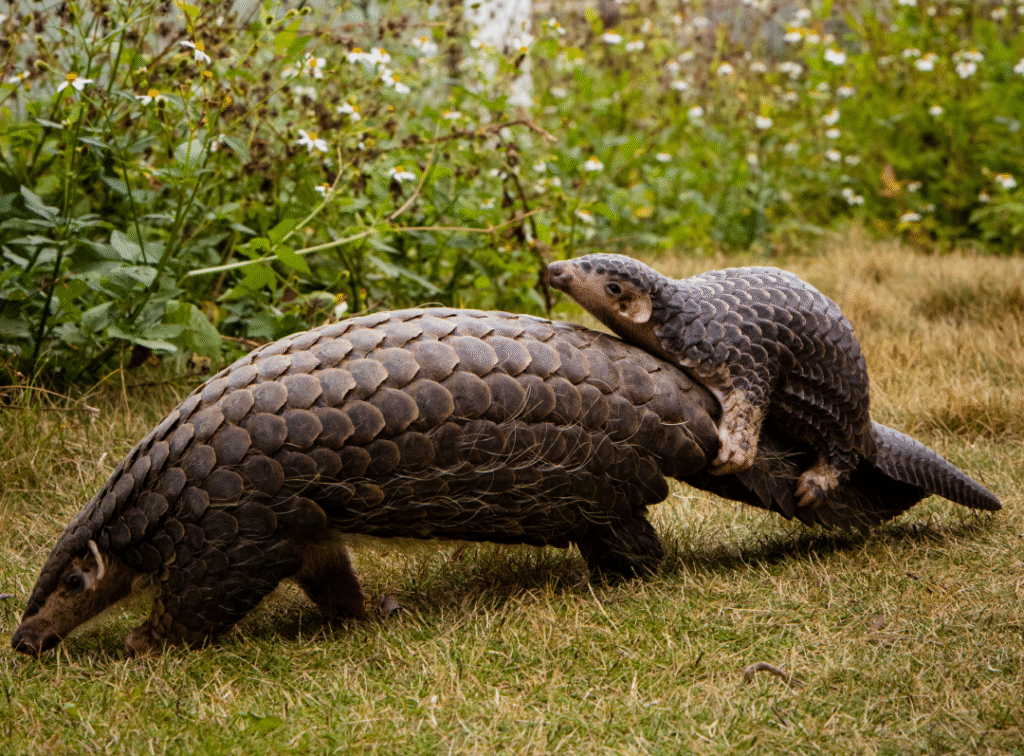
Pangolins usually give birth to just one baby at a time, weighing about three-quarters of a pound at birth and coated in soft pink scales that gradually harden for protection. A pangopup rides on the base of its mother’s tail, clinging to her scales with tiny foot claws and resting its chin on the slope of her back as it gets acquainted with the world.
If danger appears, the mother can curl around her pup, forming a protective ball with the baby tucked safely inside. Pangopups nurse for the first few months of life before transitioning to ants and termites.
Mother and pup stay together for up to two years before the young pangolin ventures out on its own. It’s hard to imagine anything cuter than a mother ambling through the woods, toting a mini-me on her tail as she forages for food!
3. A single adult can eat up to 70 million ants and termites in a year, helping protect nearby forests and farms
Pangolins are basically nature’s high-powered vacuum cleaners. Instead of teeth, they rely on an incredibly long, sticky tongue that starts deep inside the body near the pelvis and can stretch to almost the length of the animal itself. Their tapered snouts slide neatly into termite mounds and ant nests to slurp more than 20,000 insects a day — enough to help protect around 40 acres of land from damage.
They even come with built-in bug-proofing: special muscles close their ears and nostrils while they feed, keeping determined ants from crawling where they shouldn’t. Their five-toed front paws are equipped with sharp, curved claws that make digging into nests look effortless.
All that snacking makes pangolins quiet heroes of the ecosystem. By controlling insect populations and turning soil as they forage, they help aerate the ground, support healthier vegetation growth, and keep everything in balance.
4. They can walk on their hind legs
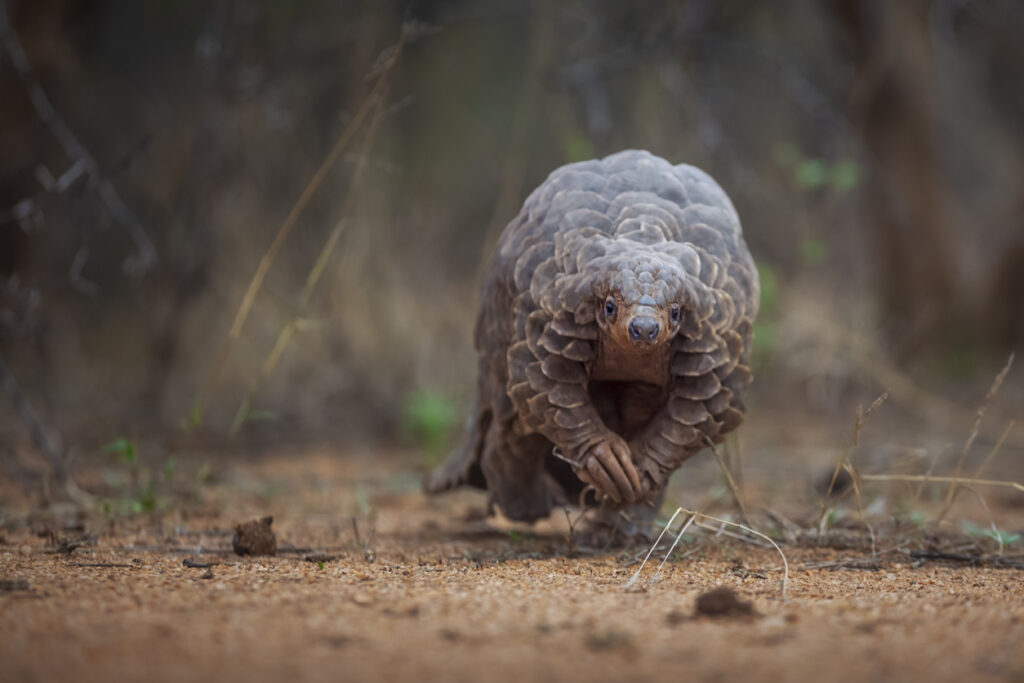
Some pangolin species are fully or partially bipedal, meaning they can walk on their hind legs, using their tail as a counterbalance or as a kickstand to prop themselves upright. They can sometimes be spotted standing with their noses in the air to get a better sniff and locate their next tasty meal, or waddling through the forest with their front limbs occasionally scraping the ground to see what’s below.
5. They’re prehistoric
There are eight species of pangolins, four found in Africa and four in Asia. Pangolins are thought to have been around for 80 million years, evolving through massive changes on Earth to survive into the present day. That makes them especially precious to our planet — a living fossil we still have a lot to learn from.
6. Pangolins are the most illegally trafficked wild mammal in the world
From their intrinsic value to their unique characteristics and vital ecosystem services, there are countless reasons to love and celebrate pangolins. Despite this, all eight species of pangolins are endangered.
Ironically, the very armor that protects them is also driving their decline. Pangolin scales have long been used in traditional medicine practices across Asia. In Africa, pangolins are widely hunted for their meat, with significant consumption in urban areas in some West and Central African countries, as well as for their scales, which are exported to Asia for use in traditional medicine.
Pangolin scales are made of keratin, which is the same protein as human hair and nails. There is no scientific evidence that pangolin scales can cure any form of disease.
There’s reason for hope. The price of pangolin scales has fallen by half or more in Cameroon in the last five years, and WildAid has observed a decline in demand for pangolin meat and scales in China as the government discourages the consumption of pangolin products and the use of scales in traditional medicine.
WildAid has been working in Cameroon to raise awareness and reduce urban demand for pangolin meat since 2022, including through the “No Pangolin on My Plate” campaign that invites restaurants to take a pledge to keep pangolin meat off menus.
“The sharp fall in the price of pangolin scales in Cameroon offers these wonderful animals a real lifeline,” said Simon Denyer, Africa program manager at WildAid. “We are seeing evidence of declining demand for pangolin products from China, while at the same time there have been some notable successes in law enforcement in Cameroon and signs that urban Cameroonians are starting to turn away from pangolin meat consumption.”
At the end of 2024, China announced a new policy strictly controlling the use of pangolin scales in medicine. Around the same time, the China Association of Traditional Chinese Medicine announced the removal of 13 patented medicines containing pangolin scales from the 2025 edition of the Chinese Pharmacopeia, the country’s official compendium of approved medicines.
WildAid continues to work with partners to reduce demand and curb illegal poaching of pangolins, helping give these animals a real chance to thrive.
So the next time you spot what looks like a pine cone that suddenly moves, you’ll know you’re looking at one of the planet’s most extraordinary and overlooked mammals.
Stay in touch and get the latest WildAid updates.
SIGN UP