


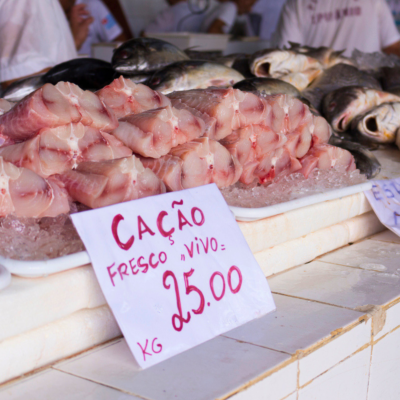
Large fish steaks line a display case in the bustling Mercado São Pedro in Rio de Janeiro. The firm, boneless fish commonly sold as cação is affordable and frequently cooked in flavorful stews.
But cação has a hidden identity. While one-third of Brazil’s 180 million urban residents consume it on a regular basis, only 40% are aware they’re eating shark meat.
This information gap extends beyond the fish market. Throughout Brazil’s seafood supply chain, retailers, restaurants, government agencies, and fishing communities also often lack clear information regarding species and conservation status.
National surveys show support for reducing consumption doubles when consumers learn that cação is shark. This suggests that the market is sustained by a lack of transparency rather than a strong consumer preference for shark products.
Building on our proven behavior change campaigns around the world, WildAid is collaborating with Brazilian partners to reduce consumption of shark meat and help shift the market toward more sustainable alternatives.
A leverage point for global shark conservation
As one of the world’s largest consumers and importers of shark meat, Brazil consumes an estimated 45,000 tonnes of shark meat annually. Researchers recently found that 83% of shark and ray species in its market are threatened with extinction.
As apex predators, sharks help maintain the balance of marine ecosystems by keeping food webs thriving. When shark populations decline, there is a cascading effect on biodiversity, fisheries, and coastal communities.
Changes in Brazil’s consumption can significantly reduce pressure on shark populations in the South Atlantic and beyond. This makes the country one of the world’s most powerful opportunities for systems-level conservation impact.
Building on emerging momentum
At a time when Brazil’s health-conscious consumers are reducing red meat intake in favor of more fish and seafood, recent research about the health risks of shark meat has raised public concern. Brazilian researchers report alarming toxin levels in shark meat with mercury, arsenic, and cadmium levels that frequently exceed regulatory guidance or legal thresholds for some species.
As awareness of these risks has grown, attention has also turned to where shark meat is being served. In 2025, an exposé by Mongabay revealed shark meat is procured in large volumes by government agencies such as schools, hospitals, and prisons for their institutional meal programs — further exposing vulnerable groups such as children, elderly, and hospital patients to high toxin levels.
Less than a year later, Latin America’s largest public hospital complex, the University of São Paulo Medical School Hospital, announced it would cancel its plans to buy more than 17 metric tons of shark meat, citing concerns over heavy metals. Around the same time, Rio de Janeiro state education department also announced a ban on serving shark meat in public schools it manages, as did the municipal governments of Petrópolis and Cabo Frio, followed by the city of Maricá.
These institutional changes coincide with an important period of regulatory development. A recent Federal Court ruling recognized concerns regarding traceability, labeling, biodiversity protection, and public health associated with the shark meat trade and directed relevant agencies to strengthen oversight and traceability systems.
WildAid is working with a coalition of stellar local partners to build on this growing momentum, including Sea Shepherd Brasil, Freeland, and NO.LAND Agency.
“There’s a whole list of world-class experts within Brazil who are totally committed to this cause. Together, we can help amplify local voices calling for change,” said WildAid President and Chief Program Officer John Baker.
A proven model for change
WildAid has protected sharks for more than 20 years through a unique combination of public awareness campaigns and an internationally recognized marine protection program. In China, WildAid has contributed to an 80% decline in shark fin demand and in urban Thailand, a 34% decline in consumption — equivalent to 8.1 million fewer servings.
In Brazil, the objective is not simply to discourage consumption, but to support a transition away from threatened shark products across the marketplace. Through partnerships with media, influencers, brands, scientists, health experts, public leaders, and community organizations, WildAid will work to shift consumer expectations and purchasing practices.
Our public awareness campaign will empower families, retailers, and institutions to make informed decisions — helping to establish a new social norm in which threatened shark products are no longer viewed as an acceptable or desirable choice. But shifting consumer behavior is only one part of transforming the shark market.
Brazil already possesses important regulatory tools relevant to shark conservation; the challenge is often implementation, compliance, transparency, and enforcement.
WildAid and its partners will support implementation of emerging traceability and labeling requirements, strengthen public support for regulatory reforms, and work alongside government agencies and enforcement partners to improve compliance throughout the supply chain.
By aligning public awareness, market transparency, and enforcement, we seek to create lasting conditions for long-term reductions in shark mortality.
Together, we can safeguard our oceans for future generations by keeping sharks off plates and in the water, where they belong. Subscribe below to follow updates on our work in Brazil and other marine protection efforts.
Stay in touch and get the latest WildAid updates.
SIGN UP