


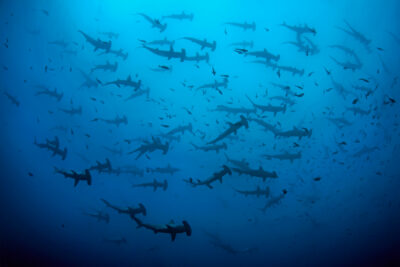
As apex predators, hammerhead sharks are extremely important to maintaining the balance of ocean ecosystems. Yet despite surviving for 20 million years, they are being threatened by overfishing and illegal fishing. Today, six out of 10 hammerhead species are listed as critically endangered on the IUCN Red List. WildAid is working to safeguard the Eastern Tropical Pacific, where hammerheads migrate every year to reproduce. Protecting these highly migratory sharks requires coordinated enforcement and collaboration across borders to help ensure their survival.
A curious shape, perfectly designed
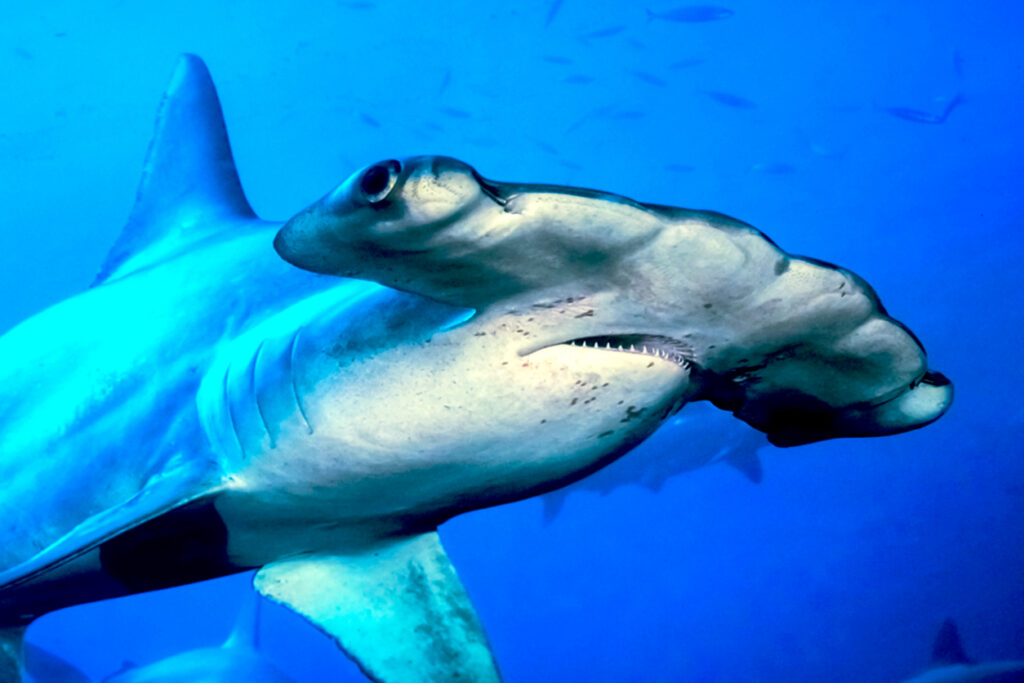
Equipped with a T-shaped head, known as a cephalofoil, and a small mouth set in a cartoonish upside-down grin, hammerheads are incredibly skilled hunters that feed on shellfish, octopus, squid, shrimp, stingray, and bony fish. Attacks on humans are extremely rare. Their wide-set eyes give them enhanced depth perception and a nearly 360° view of the surrounding waters. Their broad, flat heads contain expanded nasal capsules and electroreceptors, enabling them to detect the faintest scents and electrical signals emitted by prey, even those hidden beneath the sand. Hammerheads also use electroreception as a kind of GPS system during migration, sensing the magnetic fields of the sea floor to help navigate thousands of miles.
Motherhood across the Eastern Tropical Pacific
Unlike many sharks that lay eggs, female hammerheads give live birth after gestating their pups for 9-10 months. During gestation, pups receive nutrients via a placental cord similar to the human umbilical cord. A single litter can contain 12-40 pups, but before giving birth, these mothers must complete a remarkable journey.
After mating in open water, huge schools of pregnant hammerheads — sometimes numbering in the hundreds — migrate across the Eastern Tropical Pacific (ETP), a globally important marine corridor that touches the waters of multiple countries in the Americas. The corridor includes an “Ecologically and Biologically Significant Area” designated by the Convention on Biological Diversity, and four UNESCO Marine World Heritage Sites: the Galápagos Archipelago in Ecuador, Cocos Island in Costa Rica, Coiba Island in Panama, and Malpelo Island in Colombia.
Scientists in the Galápagos Islands recently discovered that pregnant hammerheads sync their migration with the lunar cycle. Whether due to the increased light from the full moon, the ebb and flow of the tides, or some unseen force, the hammerheads set out on the full moon as if on cue. They’ll swim an average of 30 miles per day for a month or more to reach protected mangroves along the coast of Central America. In these shallow nursery waters, their newborn pups will have the greatest chance of survival, feeding on crustaceans and remaining hidden from predators. Shortly after giving birth, the mothers return to the open sea, completing a reproductive migration that can span up to 2,500 miles round-trip. The females will repeat this journey again and again, traveling over 120,000 miles in their 30-40 year lifespan. That’s the same distance as halfway to the moon.
Threats along the migration route
Hammerheads have a very slow growth rate, reproducing only once every two years. This vulnerability is exacerbated by human pressures. Along their migratory routes, hammerheads face a gauntlet of fishing hooks and nets where they can become entangled as bycatch. And since they travel in large schools, they’re frequently targeted for illegal shark finning, a cruel and unsustainable practice.
The scale of illegal fishing in the region underscores the dangers hammerheads face. In 2025, Panamanian authorities seized six longliner vessels for fishing illegally in protected waters. An additional 10 vessels are under investigation, as surveillance data showed they had been fishing in the area (but had avoided authorities).
Historical estimates further highlight the pressure these populations have faced. In 2009, approximately 12,000 sharks were poached in a single year in the Galápagos.
Although marine protected areas exist throughout the ETP — including the Galápagos Islands — illegal, unreported, and unregulated (IUU) fishing continues to threaten hammerheads across the region.
Protecting a connected ocean
Safeguarding hammerheads requires more than isolated marine protected areas; it requires coordinated enforcement, international cooperation, and protection of the broader Eastern Tropical Pacific marine corridor.
WildAid’s marine team strengthens surveillance, enforcement, and regional collaboration throughout the ETP to protect sharks and the ecosystems they sustain.
In the Galápagos Marine Reserve, WildAid has supported joint patrols between park authorities and the Ecuadorian Navy, improved enforcement infrastructure, and helped strengthen legal responses to environmental crimes. As a result, there have been no reported shark finning cases within the reserve since 2014.
In 2024, WildAid and its partners launched a groundbreaking project to enhance marine law enforcement, biodiversity protection, and the sustainable use of marine resources across Ecuador, Costa Rica, Colombia, and Panama, with joint training activities that also include Peru and Mexico. The Strengthening Marine Enforcement in the Eastern Tropical Pacific Seascape project is designed to benefit over 15,000 coastal residents and 400 law enforcement personnel in the six target countries.
The following year, WildAid received a Bezos Earth Fund grant to provide park rangers throughout the region with the equipment and hands-on training that will make their daily work safer and more efficient. This will help teams navigate remote areas with greater confidence and ensure they have what they need to care for their waters over the long term.
The future of hammerheads depends on us
Under the light of a full moon, another school of pregnant hammerheads begins its long migration. With your support, WildAid can continue to strengthen marine enforcement and protection across the Eastern Tropical Pacific, ensuring these sharks’ safe passage for generations to come.
WildAid’s work to strengthen protection of marine biodiversity through monitoring, surveillance, and enforcement in the Eastern Tropical Pacific is graciously supported by Bezos Earth Fund, Global Affairs Canada, and Fundación PACÍFICO.
Stay in touch and get the latest WildAid updates.
SIGN UP